



I’ve been rather preoccupied in recent months with my latest book and with writing about politics and culture, but I’m going to devote more time to my bread and butter: health and fitness. Although I think esoteric health Twitter—and Twitter more broadly—is pretty much over now, I don’t want that to stop me from writing about topics I know brought many of you to my Twitter profile in the first place and to here. Please forgive me if I’ve been remiss.
Today, I want to discuss two new studies, both on the subject of chemical exposure.
The first is a study of antifungal use during pregnancy. Mothers-to-be are generally advised that over-the-counter antifungals, including topical medicines and pills, are perfectly safe to use during pregnancy. New research from Denmark, however, suggests that isn’t the case, and that more research is needed—fast.
Scientists looked at hormonal data from nearly 600 mother-child pairs, and also performed lab experiments on human fetal adrenal tissue and pregnant rats. They found that children whose mothers used a particular class of antifungals—azole-based compounds—during pregnancy had altered levels of adrenal hormones up to three months after birth.

Although levels of adrenal hormones remained within the normal range, “the results suggest that fetal development may have been affected,” one of the researchers said. It’s important to note that fetal development wasn’t the subject of the study, only hormones, but the link to altered development is clear. Adrenal levels are responsible for regulating, among other things, glucose metabolism, blood pressure, immune function, reproductive development and growth more generally.
Follow-up experiments using fetal adrenal tissue and pregnant rats confirmed the findings from the mother-child data,.
It’s not news to me that antifungals have endocrine-disrupting effects. Some time ago, I made a post on Twitter about research that showed clotrimazole, a key ingredient in many anti-fungal foot creams, is a very potent aromatase-inhibitor. Aromatase is an enzyme produced by adipose tissue that converts excess testosterone into estrogen. If you inhibit aromatase, you inhibit the conversion of testosterone into estrogen—and that means more testosterone. I joked that maybe foot creams could be the new esoteric testosterone booster.
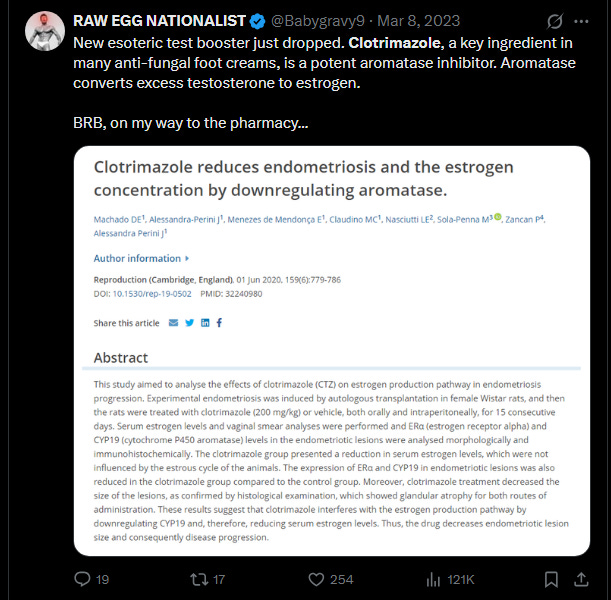
Jokes aside, though, this new research is a clear warning to avoid using antifungals during pregnancy. Further research is now needed to assess the potential developmental effects, and given the broad range of processes adrenal hormones are responsible for regulating, I’d expect a broad range of studies to be necessary.
The study is also a warning, I think, that we need to look again at common over-the-counter medicines that are assumed to be safe during pregnancy, as well as more powerful prescription medicines like SSRI anti-depressants. It’s a constant refrain of my work on medicine and food that regulatory frameworks, including testing regimes, are grossly inadequate, and this research is yet another reminder of that.
The second study links autism to chemical exposure, which isn’t exactly new or interesting in itself. But what is new and interesting is the method. Instead of looking at urine or blood samples from children or from their mothers during pregnancy, this new research used baby teeth. Baby teeth, which begin developing around the fourth month of pregnancy and continue to form until about age three, act as a permanent record of chemical exposure, unlike blood and urine, which only capture short-term exposures. Many chemicals have short half-lives, breaking down within a matter of days or even hours, which mean they can easily be missed in blood and urine samples. Not so the teeth, however. You could almost think of them like trees, laying down durable rings that remain long after the chemicals have otherwise left the body.
