


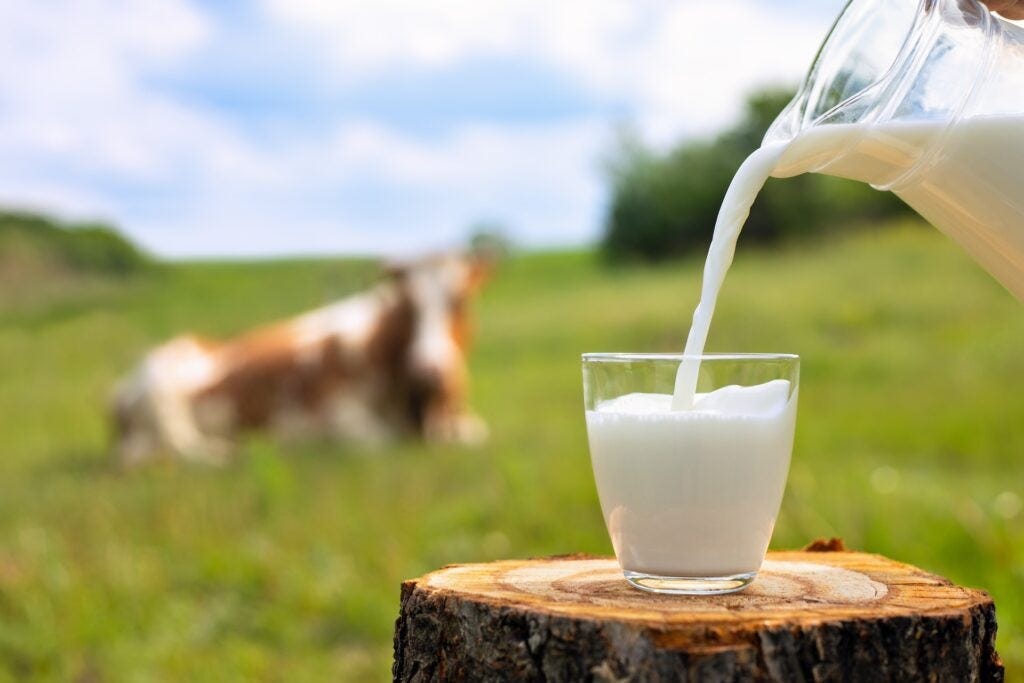
As it’s Friday afternoon and I’ve just returned from one of my favorite dairy farms—Hurdlebrook, in Babcary, Somerset—bearing enough raw milk to sustain a warband of steppe nomads through many days if not weeks of pillage and conquest, I think it only correct and proper that I should write for you today about this true food of the gods. The white stuff. Milk, glorious milk. Or, rather, stuff that’s being called milk but isn’t anything of the sort.
The enterprise to replace natural foods like meat and milk with synthetic alternatives, whether by means of genetically modified micro-organisms or by endlessly replicating animal cells, continues at great pace and great cost.
We’re told it’s necessary to save the planet from climate change, since traditional agriculture is apparently so damaging, and we’re also told these new products will be identical to the ones they replace, not only in taste but also in nutritional content. They may even be better for us, experts say.
It’s a fool’s errand for a number of reasons. Theological—because we are trying to usurp the creative powers of the one true Creator himself, so in some cosmic sense of course we’re bound to fail. But also nutritional, that is biological, for the simple fact that we don’t actually know anywhere near enough to replicate natural foods, molecule for molecule.
This latter problem is the problem of “nutritional dark matter.” A scientist called Albert-László Barabási, of the Harvard Medical School, coined that term in a paper from 2020.
“Our understanding of how diet affects health is limited to 150 key nutritional components,” Barabási wrote—and yet there are thousands upon thousands of nutritional compounds in food, meaning we understand only a tiny minority of what makes up the stuff we shovel in our gobs on a daily basis.
Meat. Fruits and vegetables. Milk. Every and any food. Thousands upon thousands of compounds whose existence we are aware of, but about which we know nothing. Many, probably most, of these compounds don’t even have a name.
The analogy with so-called “dark matter”—the 85% of stuff in the universe we know is there but lack the ability to see, even with our most advanced gadgets and gizmos—is in no sense hyperbolic.
Throughout history, the only real test of nutritional dark matter has been whether people successfully eat a food—and have done for a long time. That’s how we know it’s safe and wholesome.
One example I like to trot out involves liver. Back in the 1950s, scientists did drowning tests with rats. You put a rat in a vessel of water it can’t get out of and time how long it takes to give up swimming and die. Unpleasant, I know. Anyway, in this case, the scientists gave some of the rats liver to eat before they lobbed them into water. And what happened? The rats that ate the liver swam far longer than the rats who ate the standard chow. The scientists tried to find the exact compound in the liver that turbocharged the rats, but all they could do was show it wasn’t a b-vitamin. Today, in 2026, we still haven’t found that compound. But we know it’s there.
That’s nutritional dark matter. In that case, good nutritional dark matter. But there’s bad too, or stuff that could be bad.
The potentially bad is shown in a new study of synthetic or “synbio” milk, which is made by a genetically modified fungus in a bioreactor. The process is referred to as “precision fermentation,” and it’s basically just like brewing beer. You take inputs—protein, carbs, fat, micronutrients—feed them to a microorganism in a big vat, the little creatures do their thing, and then you’re left with a final product—in this case, “milk.”
As I say, the makers of these products claim complete equivalence with the real thing. One brand of synbio milk, UnReal Milk, says their product replicates “the nutrition, taste, and texture of traditional dairy.”
Scientists beg to differ. A new study, published in the journal Scientific Reports, found 236 fungal proteins and 93 unidentified fungal metabolites in synbio milk. None of these compounds are found in cow’s milk and, what’s worse, not one of them has any human safety data. We simply don’t know what eating them will do to you, in the short or the long term.
The study also showed significant differences in the amino-acid profile and nutritional profile compared to cow’s milk.
