


Up to now all of the essays on themes from my new book (available on the tab “The Last Men”) have been free to read, but this one’s paywalled. If you haven’t already, please consider upgrading your subscription to paid. Your generosity is greatly appreciated.
Testosterone decline. I think you know by now that’s the subject of my new book, The Last Men: Liberalism and the Death of Masculinity. And if you don’t—well, it is. In recent decades, there’s been a precipitous decline in testosterone levels—at least 1% year on year—across the Western world, with no signs of stopping, and this has clear social and political consequences, or so I argue.
Something I touch on in the book, albeit only very briefly, is the possibility of a much longer-term trend of testosterone decline in human history. How long?
How about 80,000 years?
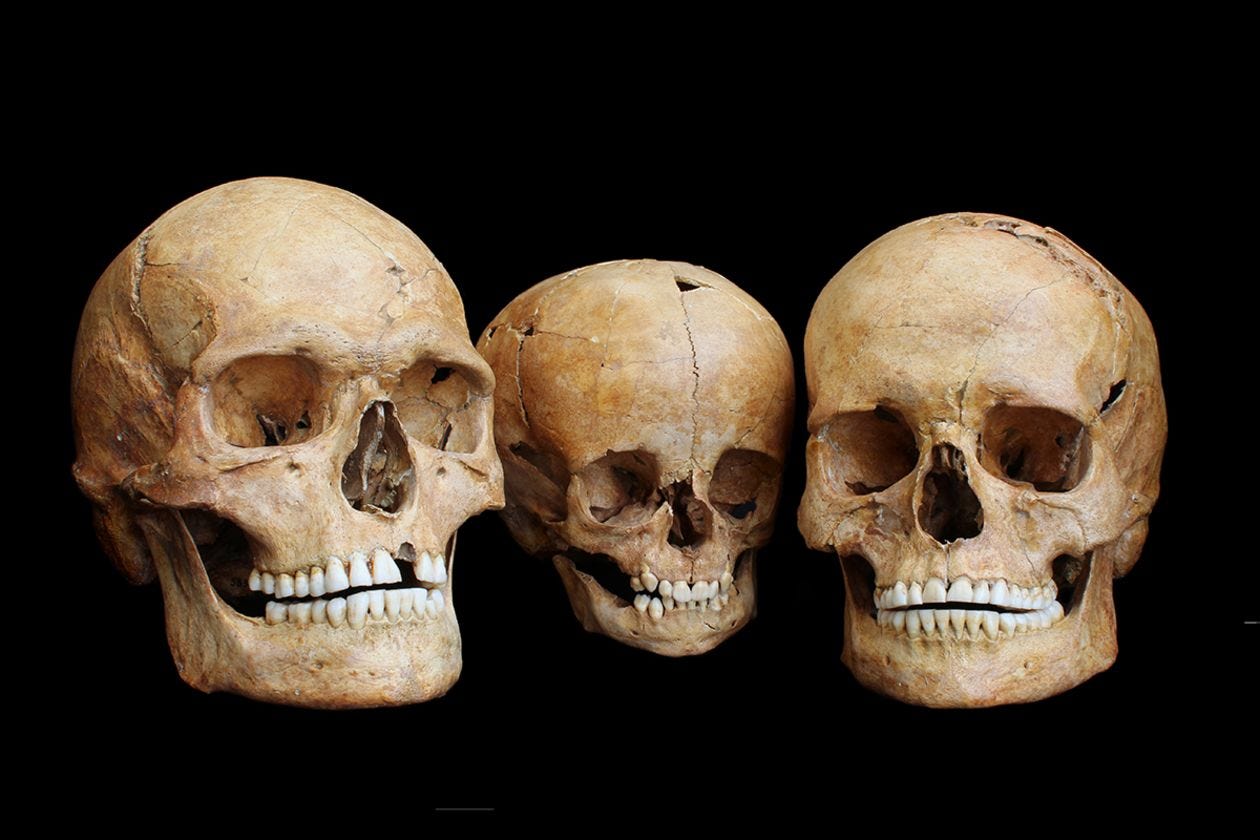
Testosterone levels may have been declining since the distant Stone Age, and we know this not because we can test the circulating levels of androgens of primitive hunter-gatherers—there are no Paleolithic soft-tissue samples—but simply by looking at the structure of their faces. Scientists say craniofacial feminisation of male hunter-gatherers and early farmers is a clear index of declining testosterone, and they think it might have something to do with the growing importance of cooperation and social complexity in primitive life.
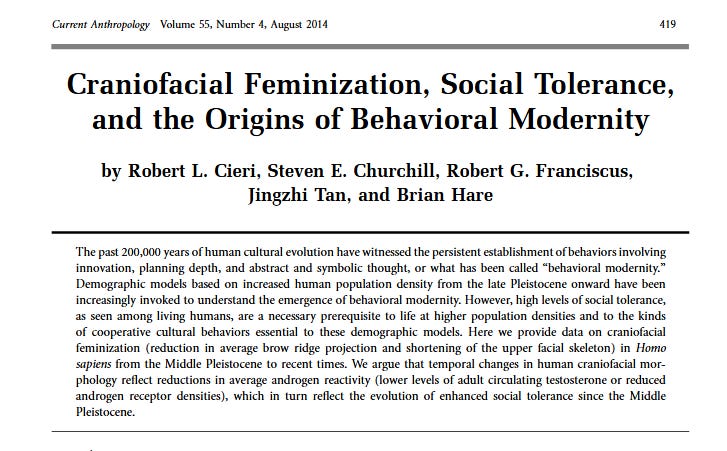
This is a possibility that was first put forward in 2014 in a paper published in the journal Current Anthropology. “Craniofacial Feminization, Social Tolerance, and the Origins of Behavioral Modernity,” by Robert L. Cieri at al. takes as its central problem the emergence of something called “behavioural modernity,” which is defined as a distinctive complex of behaviours associated with human life in its current form. These include rapid technological innovation, evidence of forward planning and the capacity for abstract and symbolic thought.
The central issue is that Homo sapiens existed for between 100,000 and 150,000 years before the first sustained evidence of behavioural modernity emerges.
So why did it emerge? And how?
