


This is a direct follow-on from my piece about Rod Dreher, which began a series of exploratory essays about the conservative character. I’m trying to understand some of the more destructive quirks of conservatives and the movements they find themselves a part of, not because I want to poke fun at them, but because right-wingers need to do something about them if they actually want to win.
In four separate experiments, researchers from the University of Queensland, Australia showed nearly 5,000 adults in the US and UK a series of hypothetical scenarios designed to gauge their empathy for political allies and enemies.
The researchers were shocked to discover that conservatives, not liberals, turned out to be the nice guys.
“Conservatives consistently showed more empathy to liberals than liberals showed to conservatives,” the researchers noted.
“This pattern—neither symmetrical nor asymmetrical in the expected direction—remains surprising.”
Surprising, maybe, but the results were unequivocal: Liberals made harsher moral judgments about “outgroup members” and also saw conservatives as “more harmful than conservatives saw liberals.”
In fact, I don’t think these results are surprising at all. They’re only surprising if you are yourself a liberal, and a naïve one at that, meaning you take yourself and other liberals at their own self-estimation: as the nicest, most moral people of all, the historical agents of equality, human rights, emancipation and Progress, who would never do anything nasty or low or that wasn’t in the interest of the Greater Good and all that. But if you actually look at the way conservatives behave—and again, as I did last time, I’m using “conservatives” as a broad term to include right-wingers more generally—you’ll see that conservatives are almost always, without exception, the ones who defer to morality and principle, expecting their opponents to do the same. Of course, their opponents do no such thing.
Conservatives almost always, fail, to pull the trigger on their enemies—metaphorically and literally. Leftists have no such qualms. Just ask Tyler Robinson.
But it’s even worse than that, I think. Because not only do conservatives fail to pull the trigger, they fail to identify their enemies in the first place. Rather than keeping their friends close and their enemies closer, so they can watch the latter and dispatch them when the time is ripe, conservatives mistake enemies for friends and completely let their guard down, inviting a knife through the ribs. Or they believe, no less disastrously, that every enemy is really a friend-in-the-making, and if they could only sit down and have an open and honest “dialogue,” all differences would disappear and everything would be hunky-dory. Fat chance.
Wasn’t that the signal failure of the first Trump presidency? That the outsider president simply didn’t recognise who within his administration was actually working against him and against the goals of America First—Pence, Pompeo, Barr, Bolton, Kushner, Fauci...—before it was too late? By the time Trump figured out what was really going on, his first term was over and he was being labelled a “threat to democracy” by some of the very people he had appointed. Mercifully, the notoriously stubborn Trump does appear to have learned a lesson or two from the 2017-2021; pre-election talk of a “retribution presidency” was not entirely misplaced.
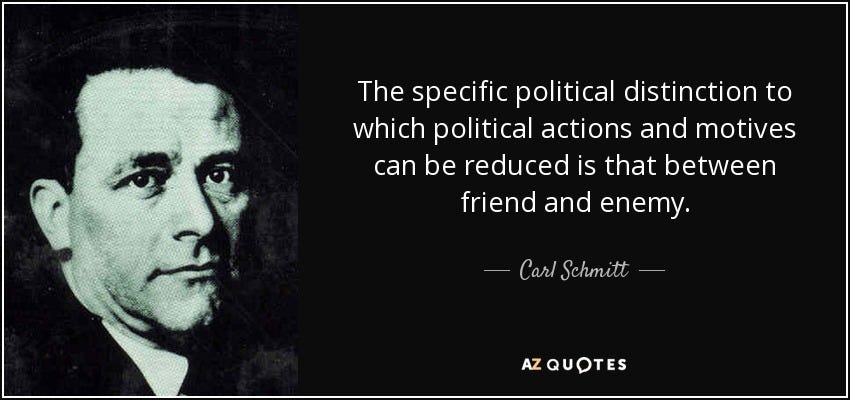
Overall, then, you could say conservatives have a problem with the “friend-enemy distinction.” I’ve said this before, multiple times in fact, but I increasingly think an unsophisticated reliance on this concept, originally derived from German jurist Carl Schmitt, is a problem in its own right, and perhaps yet another example of how so many conservatives are raped—which is to say, programmed to repeat the same traumatic mistakes over and over and over again.
The “friend-enemy distinction” comes from Schmitt’s 1932 book The Concept of the Political (Der Begriff des Politischen). The bit that always gets quoted is this single sentence, as if it can stand totally alone, without any further contextualisation or interpretation.
“The specific political distinction to which political actions and motives can be reduced is that between friend and enemy.”
