The Perfect Recipe
Secretary Kennedy's new cooking show has radical potential
I often get asked, “Charles, if you had to give people one piece of advice to transform their lives, what would you say?”
The obvious answer everyone expects, what with my being a “right-wing bodybuilder” and all, is “EXERCISE AND LIFT WEIGHTS!” And while I do think we ought at the very least to be moving a lot more than we do, and that men really should start hitting the iron to boost their testosterone, I actually don’t think it’s the single best thing you can do to transform your health.
I think the real answer is something distinctly less heart-pumping.
Learn to cook.
You don’t have to go to cookery school and don one of those silly French hats. Just learn how to cook basic meals made from good-quality fresh ingredients. The kind of things you like to eat and maybe also some of the things you should like to eat but don’t. Learn how to fry, boil and scramble eggs. Learn how to cook a steak the way you like it. Learn how to cook a chicken breast all the way through but not so much it’s as dry as Ben Shapiro’s wi—you get my drift. Make a stew and then make a lasagne and once you’ve done that make a breaded pork cutlet with some nice brown butter and a slice of lemon, maybe some capers in the butter too. Delicious.
If you learn to cook, you can control what goes in to your own body. And that means you don’t have to rely on other people to make food for you, and what I really mean by that, of course, is that you don’t have to rely big corporations to make your food in a factory. Because the truth is, the vast majority of us aren’t relying on skilled local artisans—the baker, the butcher—to make our food for us if we don’t make it ourselves. Many communities don’t even have bakers or butchers any more. It’s companies like Kraft-Heinz and General Mills, and what they really care about isn’t your health and wellbeing, it’s their bottom line and making sure you keep eating as much of their products as possible.
These companies have legions of so-called food scientists working for them whose sole aim is to make the food as addictive as possible. They call it “hyperpalatability” in their jargon, the perfect combination of sweetness, saltiness, crunch and other food sensations; a combination that makes you reach the “bliss point” where stopping eating becomes an act of conscious willpower beyond the capabilities of most people.
The essence of ultraprocessed food, the novel food type that makes up the majority of Americans’ daily calories today, is that it’s calorie-dense and addictive. It’s also packed with a myriad of weird and wonderful ingredients whose effects are largely unknown thanks to the laxness of food regulation in the US. After the Food and Drug Administration introduced a special loophole called Generally Recognized as Safe in the late 1950s (“GRAS” for short), food manufacturers have spent the last sixty years creating new ingredients, saying they’re safe and then just adding them to the food supply without any independent testing whatsoever.
Nobody even knows how many ingredients there are in America’s food. Some estimate 10,000. It could be more. In the EU, by contrast, where food quality is taken much more seriously, there are about 2,000. This is before we get on to the herbicides, pesticides, food-contact chemicals, microplastics, heavy metals, antibiotics and pharmaceuticals, and other contaminants that are also found in great abundance in cheap, factory-made food.
The transition from locally produced, fresh, home-cooked diets to diets consisting largely or entirely of foods made in factories is one of the main reasons chronic disease rates have exploded over the last century and Americans are the sickest people on earth. A full 70% of Americans are now overweight or obese. One in 31 children has an autism diagnosis. Rates of diabetes, digestive conditions, neurodegenerative diseases and various cancers are all rising fast, especially among the younger generations. It’s a dietary change as profound as any in human history, and built in large part on the promise of convenience for people who have come to see time as money and little else.
The quietly radical power of learning to cook is the reason why my very first book was a cookbook, Raw Egg Nationalism in Theory and Practice: Cook Good with the Raw Egg Nationalist. I was lucky enough to grow up in a home with a mother who knew how to cook, and one of her many loving gifts to me was an appreciation for real food and also the ability to make it myself.
It was always clear to me, then, that if America was to be made healthy again, as Secretary Robert F. Kennedy Jr. has vowed, it wouldn’t be enough just to tackle the corporations perverting and polluting the food, air and water supply. Americans would need to be shown what real food is and, just as importantly, how to make it.
Thankfully, Secretary Kennedy gets that too. At a USDA event back in March, he said home-cooking was an urgent priority that was going to be addressed in a number of different ways.
“One of the challenges we’re facing and that we’re working on—all kinds of innovative devices to solve—is that Americans have forgotten how to cook,” Kennedy said.
Americans could feed themselves better food for less, he continued. They just lack the know-how and often the equipment too.
“The convenience of fast food is one of the things that attracts them. And many of them don’t have cutlery, they don’t have pots and pans, they don’t have cutting boards, and they don’t know how to shop.
“And one of the things that we’re talking about now to HHS is to use the Commissioned Corps or other groups within our agency to go out and actually teach people to cook.”
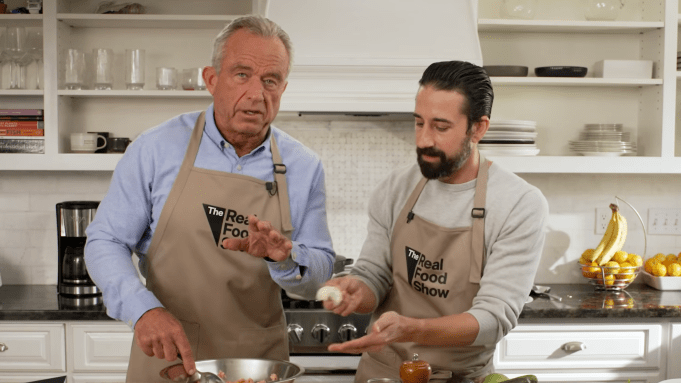
We haven’t got the Commissioned Corps going out into American communities to teach ordinary people to cook—not yet—but what we have got is a new cooking show on YouTube called “The Real Food Show.” The first 20-minute episode debuted at the end of last week and featured Secretary Kennedy and chef Andrew Gruel showing Americans how to cook a simple but delicious meal of salmon fishcakes with a green-apple salad.
The premise of the show is simple. Each meal illustrates the core principles of Secretary Kennedy’s new nutritional guidelines and his updated, inverted, food pyramid. The emphasis is on high quality protein and fat, with minimally processed ingredients. And, just as importantly, each serving should cost less than $5. Nutritious and affordable.
Affordability is key, because one of the weapons being wielded against Make America Healthy Again, with the support of ultraprocessed-food makers, is the claim that eating well is elitist: something only a privileged few can afford. This new show cooks that canard perfectly.
I have high hopes for this series and its simple but radical message. And who knows? Maybe Secretary Kennedy and I will reprise our double-routine from the 2022 Tucker Carlson documentary The End of Men?
In fact, I know just the perfect recipe.


