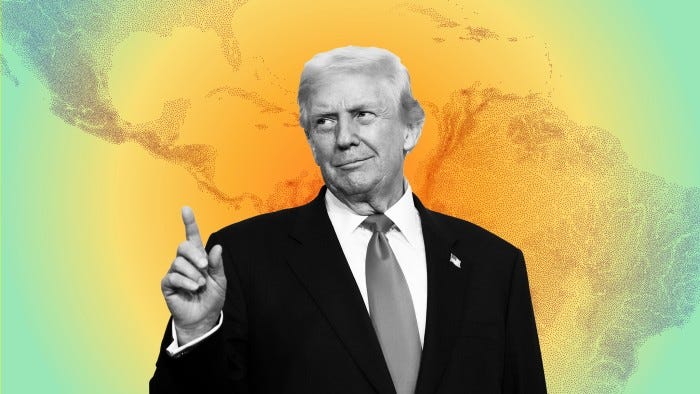
The Donroe Doctrine
Military adventurism must not distract the Trump admin from its primary tasks at home
“The Monroe Doctrine is a big deal. But we’ve superseded it by a lot—by a real lot. They now call it the Donroe Doctrine. I don’t know. The Monroe Doctrine—we sort of forgot about it, very important, but we forgot about it; we won’t forget about it anymore. Under our new national security strategy, American dominance in the Western hemisphere will never be questioned again.”
Those were the words of President Donald Trump, at a press conference today at Mar-a-Lago, announcing a successful end to the military operation to depose Venezuelan dictator Nicholas Maduro.
It was over before it began.
I was there this morning, reporting as events unfolded. Which is to say, I was glued to Twitter, in my dressing gown, coffee mug in hand, doing what I normally do every Saturday morning for INFOWARS: looking for stuff to write about.
And how quickly events unfolded. No sooner had I posted the first few stories about reports of explosions in Caracas and the possibility that a delegation of Chinese diplomats might still be in the city, than Trump announced via Truth Social it was all done and dusted. Maduro was caught, nabbed in his pyjamas by an elite team of Delta Force WANGHAFs, and taken to the USS Iwo Jima. Mercifully for him, he has his wife for company.
No US service members died, and not a single piece of kit was lost either.
Later, Trump posted a picture of Maduro: bound, wearing a white Nike tracksuit, headphones and blinders. Sic semper tyrannis—well, sometimes anyway.
It was a stunning thing, executed with the utmost professionalism by the finest soldiers, sailors and airmen of the world’s most powerful military.
But it also had the unmistakeable stamp of TRUMP on it—not least of all in the decision to destroy the mausoleum of Maduro’s predecessor, Hugo Chavez, on mountain barracks overlooking Caracas. It was like Barney Frank’s nipples or calling Rosie O’Donnell a “fat pig”: another unique insult, delivered from the missile tubes of an Apache gunship flying low over the city skyline at night.
Overkill, perhaps, but symbolic and of course very personal. Godspeed, Hugo!
For years, we were promised a tropical nightmare if the US ever made the mistake of attacking or, worse yet, invading Venezuela. Thousands of American soldiers would die, we were told, and billions of dollars of taxpayer money would be wasted.
A long, costly engagement down south—an Iraq in Latin America, as my friend Jack Posobiec puts it—would have been a disaster for the Trump administration. In fact, it would end the Trump administration, and with it the hopes of millions of Americans to make their nation great again.
The American public does not care about Venezuela: The polling is crystal clear. Americans might yet care about Venezuela if they see a reduction in gas prices at the pumps, as is likely, but a fresh meat and money grinder—nope, no thanks. We’ve had enough of those. An Iraq II: Electric Boogaloo would have made a Republican loss in 2026 a certainty, and in 2028.
Thank God that hasn’t happened, and almost certainly won’t; although many details of Venezuela’s governance, including who takes over from Nicholas Maduro, still remain to be sorted out.
The effects of US regime-change in Venezuela will be felt across the world and most keenly, I’m sure, by America’s enemies and competitors.
At a stroke, the US now effectively controls half the world’s oil reserves. That’s close to 20 trillion dollars of oil. Russia’s most effective bargaining tool—her only one apart from her nukes—will be largely ineffective. The US could drive prices down to $50 a barrel or less, depriving the Kremlin of vast quantities of roubles in tax. The mood in Russia, and on Russian social media, is funereal. China, which relies heavily on cheap oil from Venezuela, may be forced to inject a huge stimulus into its flagging economy—if the regime can bring itself to stop lying about the country’s performance.
In just a few hours, again, with a single decisive move, Trump upset the global chessboard, and the pieces fell in America’s favour.
The real danger of the Donroe Doctrine, as I see it, does not lie abroad, but at home. An increasingly assertive foreign policy—a return to the Thrasymachan ideal of “might is right”—could be used to distract from the Trump administration’s failures on American soil, and nothing will get done.
The incredible ease with which Trump deposed a dictator and tipped over the global apple cart reveals a terrible weakness: Executive Power in the US is only effective outside her borders.
There’s no better illustration of this depressing fact than the case of Kilmar Abrego Garcia, the “Maryland Man” who seemingly can’t be deported from the US, despite being an illegal, an MS-13 gang member and a human trafficker to boot.
Abrego was sent to El Salvador’s terrifying CECOT prison on a deportation flight, only to return at the order of an activist judge for a long drawn-out hearing that may yet see him remain in the country, ticking down the clock to 2026, and then 2028 and the return of the Democrats to power.
A pessimist like Curtis Yarvin believes the opportunity for meaningful action—for “regime change” as he calls it—has already passed, and the Trump admin is now unable to fulfil any of its promises, including deporting 20 million illegal immigrants. Yarvin has been wrong about many things—spectacularly so about the pandemic, for example—and I think he’s wrong here too. The Trump administration can still achieve meaningful change, and set the stage for Trump’s successor to go further.
But even so, if the window hasn’t already closed, it is closing. Fast.
In the hours since Maduro was taken, Trump reiterated that Gustavo Pietro, Colombia’s President, should “watch his ass,” and that something must be done about Claudia Sheinbaum, the Mexican President, and her refusal to tackle the cartels. Two more targets for the Donroe Doctrine.
Honestly, it would be great if the full force of the US military vaporised the cartels once and for all, and a strong case could be made for the benefits this would bring ordinary Americans. The flow of fentanyl from Mexico must be stopped. Hundreds of thousands of Americans have died because of that evil drug. No more.
But action abroad must not take precedence over action at home. Even more importantly, it must not disguise inaction on the policies Donald Trump was elected to enact. America—the American people—First.


"The incredible ease with which Trump deposed a dictator and tipped over the global apple cart reveals a terrible weakness: Executive Power in the US is only effective outside her borders." You could say, then, that even when mom argues with dad about what happens in the home, dad can oftentimes still protect the household by what he accomplishes outside the home. Given the ratty internal state of the household, it would be much better if mom and dad could come to some accord, though.
This incredible, perfectly executed show of force came right on the heels of the end of a tv show that played the military as stupid and not as brave and smart as a bunch of dramateens. Now, if Trump moves on to sorting out election interference *at home*, I'll be very appreciative.