


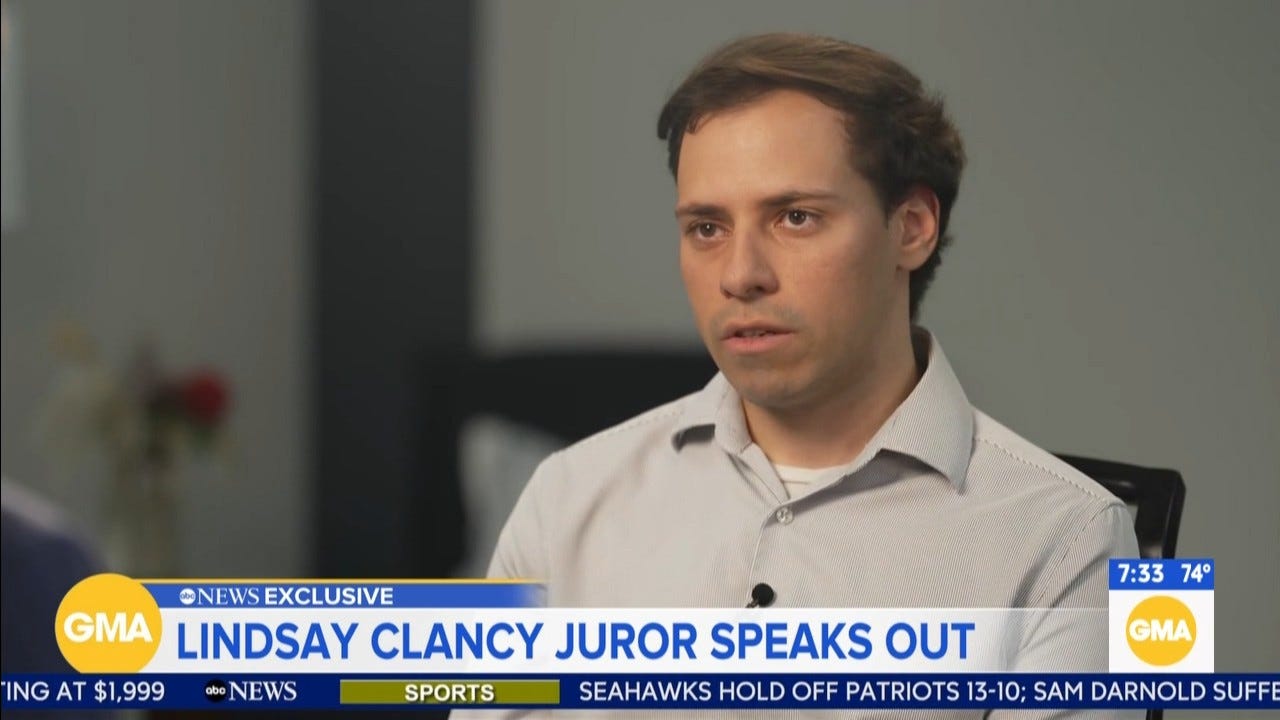
If the lone male juror isn’t the hero we need, he may very well be the hero we deserve.
I’m talking, of course, about the African American man who refused, against the wishes of the other 11 jurors—nine female, two male—to find Lindsay Clancy not guilty of the murder of her three children by reason of mental disease or defect.
His lone stand may not, in fact, conjure Horatius Cocles defending the pons Sublicius against the rampaging Etruscans, as some of us initially thought; nor indeed Spengler’s legionary who refused to abandon his post during the eruption of Vesuvius, simply because no-one had told him to do so—forgive me that reverie, please. But the case does, at least, tell us something about the nature of justice in America in 2026: where America is, and where she’s heading.
The tl;dr? Nowhere good and somewhere even worse than that. Sorry.
On Friday, Florida Governor Ron DeSantis offered the lone male juror “asylum” in Florida if his persecution continues. And he is being persecuted: hounded, his reputation, such as it is, impugned, simply for his refusal to absolve Lindsay Clancy of her guilt.
After days of speculation and discussion about the man responsible for bringing the Clancy case to a mistrial—including interviews with jury members who expressed their anger at his “arrogance” and inability to “articulate anything” during the deliberation—NBC 10, a local Boston station, released a report that revealed his history of alleged domestic violence, a restraining order against him and some $12,000 in unpaid rent to his landlord.
DeSantis called the report a “new low for legacy media.”
“A man objected to allowing a woman to kill her three kids and get away with it, so NBC is trying to smear that juror, whose identity should be protected,” he wrote on X.
“If the juror is being harassed, Florida will provide asylum—I’m sure he’d be welcomed and appreciated.”
The Lindsay Clancy trial obviously isn’t the first time there’s been a media circus surrounding a high-profile legal case.
One of the best examples dates all the way back to 1954: the Sam Sheppard murder trial. Newspapers published jurors’ photos and addresses; jurors were snapped entering and leaving the courthouse and given opinions and comments from members of the public. Twelve years later, the Supreme Court struck down the guilty verdict, citing the “carnival atmosphere” and the failure of the judge to shield the jury from the media.
Many of us, myself included, will remember the insanity of OJ—“If the Bronco doesn’t fit, acquit!”—and then more recently the frenzy of the Casey Anthony trial. In the OJ case, jurors were sequestered for months with heavily restricted access to newspapers. Their contact with the outside world was scrupulously monitored. And yet still they managed to reach the wrong verdict.
Oh yeah, and Derek Chauvin, America’s foremost political prisoner, was tried in a courthouse behind barricades manned by the National Guard. Don’t tell me that was fair.
Lee Kuan Yew, the great visionary leader of Singapore, abolished trial by jury in 1969. Juries had already been restricted to capital cases in the fledgling city-state ten years before. Lee articulated his reasons for the ban clearly. He famously told a story about how, as a young lawyer, he had managed to get four Muslim men off the hook for murdering a British Air Force officer and his family. Lee did this with standard lawyerly techniques. He picked holes in testimony and he appealed to the “weaknesses of the jury: their biases, their prejudices, their reluctance really to find four Mussulmen guilty of killing… an RAF officer, his wife and child.” Although Lee knew he had “discharged his duty” as a lawyer, he knew he could have “no faith in a system that allowed the superstition, ignorance, biases, and prejudices of seven jurymen to determine guilt or innocence.”
The jury system, Lee said, was a “foolish, completely incongruous system” imported from Britain and completely unsuited to Asia, and especially to a multiracial, multi-religious state like Singapore, where a lawyer could play on the tribal loyalties of particular ethnic groups, rather than a shared commitment to an objective ideal like justice and the truth. Lee said all these things in parliamentary speeches, and in a 1977 BBC interview.
America in 2026 isn’t much different from Singapore in 1969. A burgeoning multi-racial state where deep Anglo assumptions that had once ruled can no longer be taken for granted. That writing was on the wall with the OJ trial, for those who had the presence of mind to see it. It was clear even then that certain kinds of crime, with certain defendants, in certain parts of the country would probably never yield a fair result. When the OJ trial was held Downtown, with a jury pool that was more heavily African American, you got one result. When the civil case was later held in Santa Monica—where the murders actually happened—you got another. Same case, same evidence.
