


Just a quick reminder: My new book, The Last Men: Liberalism and the Death of Masculinity, is now available in hardcover, Kindle and audiobook formats via Amazon. I’m going to be in the US over the next three weeks promoting the book, including events in New York, Washington DC and possibly Los Angeles and Florida too. The first will be in New York on Friday 23rd January. Details to follow.
A while ago, I wrote a piece calling for a new “Golden Age of Cholesterol,” in which the dietary wisdom of our ancestors would be recognized again and embraced, at long last. Lashings of cream and butter, endless servings of steak, bone marrow, and—of course—dozens of eggs.
“The first Golden Age of Cholesterol—that was basically all of human history right up until the twentieth century,” I wrote. And it’s true; although our ancestors obviously didn’t know what cholesterol was or why it was important. They just knew to eat foods that happened to contain a lot of it.
Nutrient-dense animal foods: As the great pioneering dentist-cum-anthropologist Weston A. Price showed, traditional and small-scale societies prized this type of food above all others.
It didn’t matter whether Price was north of the Arctic Circle with the Inuit, or wandering the banks of the Nile with the pastoralist Nuer, or swimming with pearl divers in the South Pacific—in every instance, where the people displayed “perfect health,” they were eating nutrient-dense animal foods, without fail.
They might eat other stuff too—the Inuit liked to eat fermented moss and greens straight from the stomach of dead caribou, for example—but always they prioritised and built their diets around organ meats like liver; fatty cuts; milk and dairy products like butter and cream; eggs; shellfish, crustaceans and fish like salmon.
Price travelled the world in the 1920s and ‘30s and presented his findings in the greatest book about diet you’ve never even heard of, 1939’s Nutrition and Physical Degeneration.
By the 1920s, the march of industrial foods had begun—the very first processed foods like refined-wheat products, canned goods, preserved fruits and sugar syrups—and the effects were dismal. At home in Cleveland, at his dental practice, Price saw patients whose mouths were riddled with decay. The effects were most pronounced in the children he saw. It was as if the very structure of their faces was collapsing. Their jaws, cheeks and noses simply weren’t forming properly.
Price knew it was the new industrial foods they were eating, which is why he set out on his globetrotting adventure in the first place. He wanted to prove that refined industrial diets couldn’t provide the nutrition humans need to develop properly.
That we abandon the old ways at our peril.
America did not heed Price’s warning. Instead, she abandoned the old ways with gusto. Animal foods were demonised as unhealthy, precisely because of their saturated fat and cholesterol content, and we were told to eat as little of them as possible. In the late 1960s, eggs became the only food in American history to have a specific health warning attached to their consumption.
By breaking with the past, we were promised renewed health and better lives. Instead, we became sicker than ever before, and more dependent on medicine and the products of pharmaceutical research than it would ever have been possible to imagine outside the pages of a science-fiction novel. Corporations gained control over the food supply, from field to plate.
America has become the most unhealthy, unhappy nation on earth, closely followed by the other nations of the West—and now, increasingly, the rest of the world as it develops and follows our patterns of living and eating.
At the end of my piece, I imagined a situation in which you visit your doctor, and instead of prescribing a fresh round of pills and pharmaceuticals, he tells you to buy a fat ribeye steak and cook it in butter.
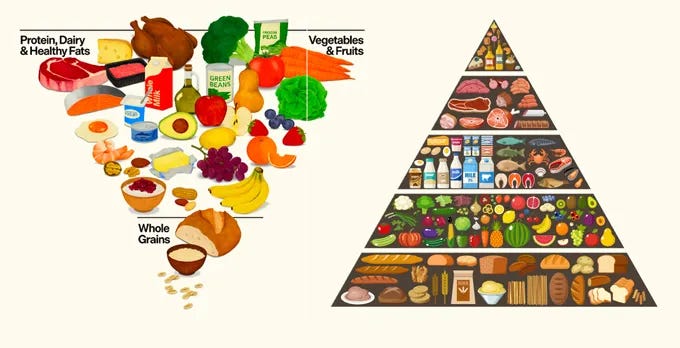
Fanciful? Maybe. But last week we came a little bit closer to that reality.
