


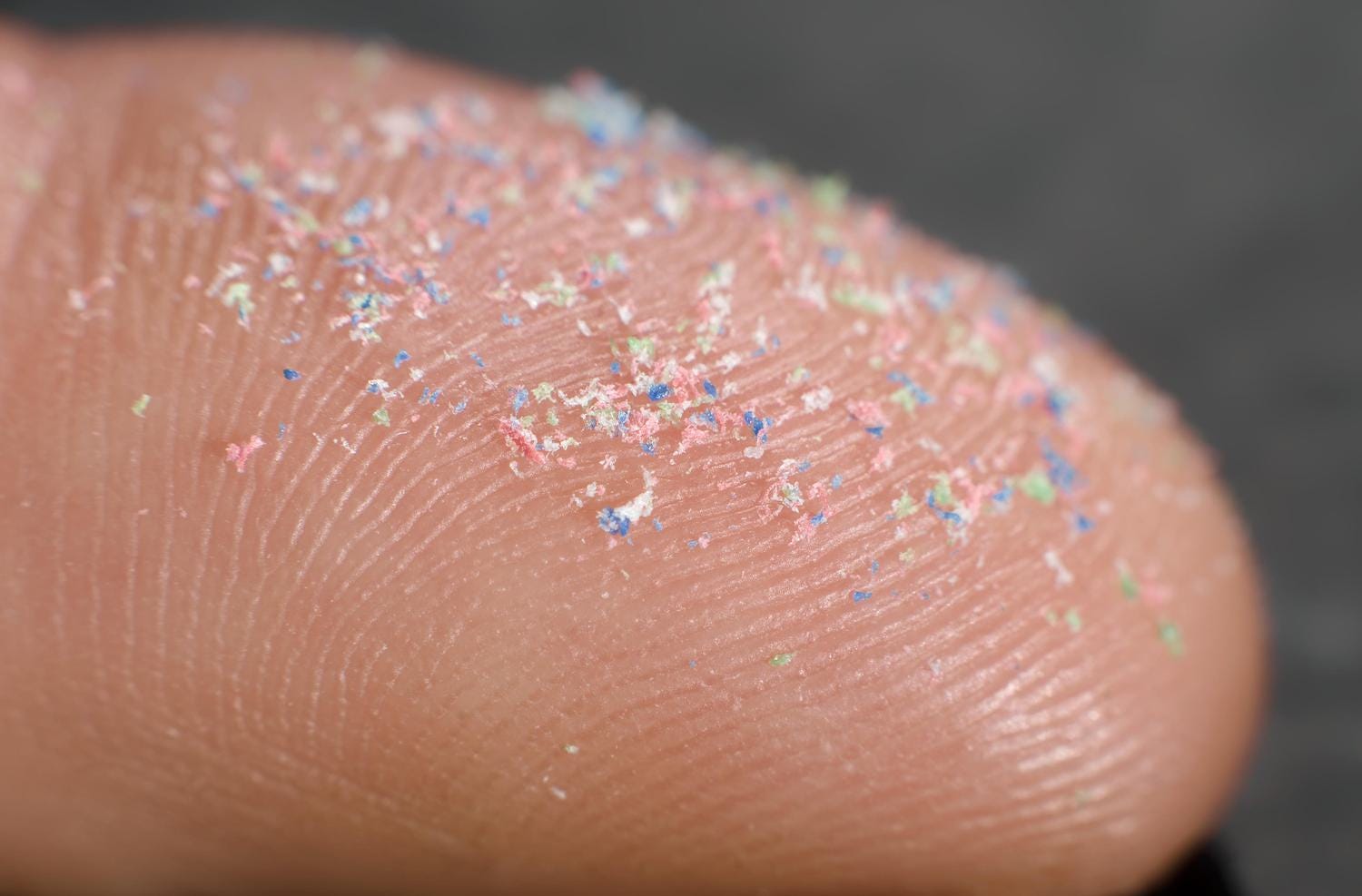
For the very first time, scientists have watched nano-plastics—the even smaller, even trickier kind of microplastic—enter a living animal cell. It wasn’t that we needed confirmation this could happen, because we’ve known that for years; it’s that we’d never seen it happening in real time, and we didn’t know the exact mechanisms behind it. The new research underlines how little we still know about microplastics, despite growing recognition they may be one of the greatest threats to human health today. Exposure has been linked by one reproductive-health expert to a civilizational decline in sperm counts that could make natural reproduction impossible as early as the middle of this century.
The study, published in Environmental Science: Advances, was conducted by scientists at Tokyo University of Science in Japan. They created special nanoplastic particles and then dyed them using a fluorescent dye, so they could be tracked easily once they entered animal cells in the lab.
Almost all prior research on microplastics has used spherical beads of polystyrene, mainly because they’re easy to produce and work with. But these beads aren’t like the microplastics humans and animals are actually exposed to. Most microplastics are irregular and jagged in shape, the product of environmental wearing of one form or another: sunlight, mechanical abrasion—being bashed by waves, trampled underfoot, shearing off rubber wheels as they run across tarmac, etc. —and digestion by organisms including bacteria, fungi and plankton.
(It’s reckoned a single rotifer—a species of plankton—can produce between 348,000 and 366,000 nanoplastic particles every day. In China’s largest freshwater lake, Poyang, researchers estimate plankton may be producing 13.3 quadrillion nanoplastic particles a day. There are fifteen zeroes in a quadrillion, by the way.)
Realism matters in scientific experiments, and microplastic research is no different. Studies have already shown that different shapes have very different effects. Irregular microplastics have far more serious effects on the swimming ability of small fish, for example, and they also spend more time in the digestive tracts of crustaceans than perfectly regular spheres.
The specially prepared realistic nanoplastics were made to fluoresce using a dye called “Nile red” and then added to blood proteins to prevent them from clumping together. Different kinds of plastic were used, so the researchers could study whether they behaved differently when entering animal cells.
Fibroblast cells, a common type of cell found in the connective tissue of mammals, were then exposed to the fluorescent nanoplastics for 30 minutes, washed, and examined under a special electron microscope.
The researchers discovered that the plastics had accumulated in the cells’ cytoplasm—the gooey interior—around the nucleus, where the genetic material is stored. This suggests, clearly, that the particles were absorbed into the cell in the same manner as useful products like nutrients are brought inside. The process is known as “endocytosis,” and involves wrapping substances in special membranes that allow them to cross the cell wall and get inside.
In basic terms, natural healthy cellular processes are helping to smuggle in toxic pieces of plastic.
None of this is particularly exciting or sexy, and I apologise if, up to this point, I’ve struggled to hold your attention.
A little bit of context should liven things up a bit.
More than nine billion tons of plastic are estimated to have been produced between 1950 and 2017, and over half that total has been produced since 2004. The vast majority of that plastic has ended up in the environment, where it breaks down into smaller and smaller pieces of plastic, some of which will end up in our bodies.
