


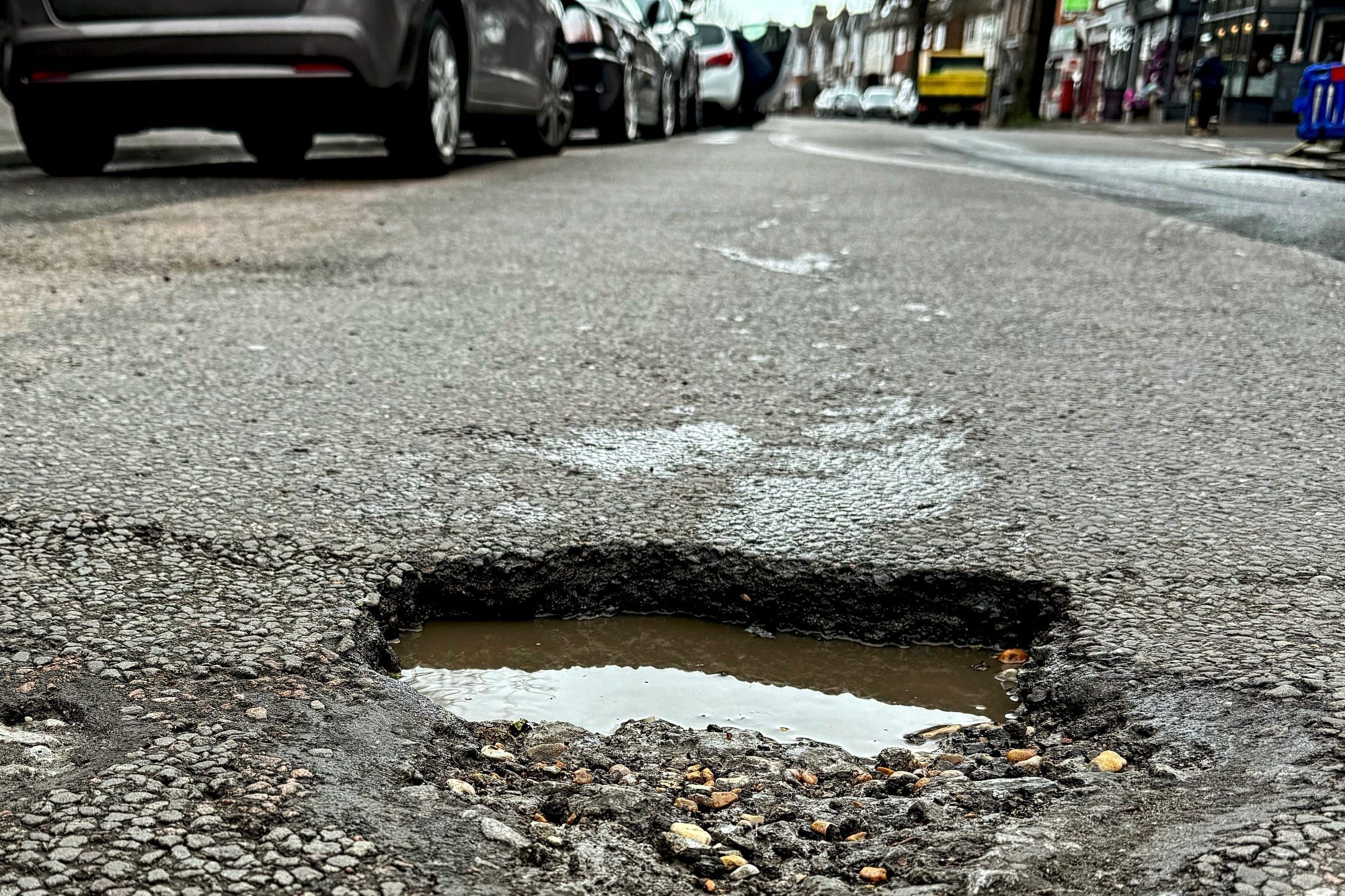
Councillor Gibbins pressed the button. The assembled crowd held its breath. For a few moments, the hulking machine—looking like some unholy bastard-child of a wood chipper, a cement mixer and a tractor—sat idle, unmoving. And then—
With a loud rattle and a series of clanks and a strange gurgling noise like water going down an enormous drain, the contraption sprang to life.
The machine began to move along the road, slowly filling in the deep holes with a thick dark steaming treacle-ish substance.
The smell was anything but sweet.
From within the great metal hull, a sound very much like the muffled agonizing screams of humans being contorted, compressed, heated, liquified and canalized could be heard.
Councillor Gibbins smiled at his handiwork.
“Promises kept,” he said, as the first flashbulbs went off.
On the pavement nearby, Reform UK’s deputy leader, Richard Tice, was being questioned by the BBC’s Laura Kuenssberg.
“Mr Tice, many voters have serious concerns about Reform. On a number of occasions you’ve had problems with candidates who have expressed views that have been extremely offensive. Now, one of your councillors who’s been elected here, in Sunderland, is turning Ni—”
“No, Laura, I know what you’re going to say, and I’m simply not going to have it. We’ve heard all this smearing and sneering before. Let me tell you what people are really concerned about. I’m going to talk about the scourge of anti-semitism, which is the greatest threat facing us here, in particular in London, and elsewhere across the UK. That’s what people are really concerned about. We stood up strongly for the Jewish community. And as people say daft things, of course it’ll be looked at. But you know, let’s just remember we’ve got a party that has been successful; that is not the anti-semitic Green Party. That’s what people are most worried about.”
“But Mr Tice, look, I can see a pair of teeth sticking out of the tarmac—and look! there’s what appears to be a big toe or a thumb! There’s a pair of lips! Mr Tice! Your councillor is melting Nigerians before our very eyes and using them to fill holes in the road and all you—”
“No, I’m sorry, Laura, I just can’t accept that. I condemn anything that’s wrong and inappropriate. The key point here is that voters have heard all of this smearing and sneering against us and they’re sick of it. They want action. They want a party that can deliver. And that’s what Reform is doing here today. We’re doing what Labour and the Conservatives both refuse to do, which is sort out the terrible state of Britain’s roads. Now, you’ll have to excuse me. I’m off to County Durham. One of our other new councillors has just come up with a marvellous way to create totally renewable, eco-friendly fertiliser for our hardworking British farmers, and best of all it will help get net migration down…”
The biggest story of last week’s local council elections in the UK wasn’t the victory of Glenn Gibbins in Sunderland, a man who was discovered to have joked—on Facebook of all places—about melting Nigerian immigrants to fill potholes.
A bigger story: So far, Reform haven’t suspended or ejected Glenn Gibbins from the party, despite the screeching and gnashing of harridans like the BBC’s Laura Kuenssberg and the childless cat-ladies of X. Instead, Reform MP Robert Jenrick posted a video on X today in which he trumpeted Reform’s efforts—to fill potholes. The British public are tired of empty moralizing and vacuous grandstanding, and Westminster is, at last, waking up to that fact.
Like with Trump, the spell of “propriety” may finally be broken. That’s big news indeed.
But the biggest story is, of course the scale of Reform’s victory, which may or may not, in percentage terms, be quite as large as in the 2025 elections, but even so has taken place on a much wider scale, nationwide.
Nigel Farage, Reform’s leader, said his party’s sweep—about 27% of the national vote—had brought a “truly historic shift in British politics.”
Wins came across the UK, including in places that were traditional Labour and Conservative strongholds: Reform stole from both left and right.
“We won the biggest national vote share for the second year running, gained more than 1,450 seats and took control of 14 councils,” Farage said.
“We won those seats right across the country, from Wakefield to Walsall, from Sunderland to Suffolk, and everywhere in between. And in Wales, we came from nowhere and finished a close second, winning 34 seats in the Senedd and ending 27 years of Labour rule.”
The Conservatives, by contrast, Reform’s main competitor right of the center, have been reduced to a “rump” in Farage’s words: a regional party that doesn’t even have a heartland, a place where its candidates are safe, anymore.
As The New York Times put it in an article on the “four key takeaways” from the elections, “Britain has entered an era of multiparty politics.” The century-long period when politics was dominated by Labour and the Conservatives is at an end, or looks to be. At long last.
