Gut Feeling
Bacteria in our guts may be driving levels of estrogen in our bodies higher
A quick preface before we get into the thick of things. If you enjoy reading my work and you’re only a free subscriber, please consider upgrading to a paid subscription. Your generous donations are greatly appreciated and put to good use: I wouldn’t be able to write and produce like I do without you. Thank you.
We live in an estrogen-dominant civilisation: That’s one of the main contentions of my new book, The Last Men: Liberalism and the Death of Masculinity.
In fact, I believe our civilisation may be unique in human history to the degree it promotes estrogen at the expense of the androgens—the masculinising hormones—and in particular testosterone. This has important consequences not just for our individual health and happiness, but for society. It also influences politics in important ways—but the relationship between politics and biology is a tricky one most would rather shy away from addressing, for obvious reasons.
Societies are many things. One thing every society is—although you wouldn’t get much sense of this from reading history, sociology or most mainstream science—is an hormonal environment. A unique hormonal environment. Various different factors—diet, lifestyle, the physical environment and climactic conditions, social institutions—coalesce to promote certain hormones at the expense of others, and the expression of behaviours associated with those favoured hormones.
Hormones, by the way, before we go any further, are biological messengers. They tell our cells and tissues to do certain things, like building muscle fibres or releasing an egg once a month to be fertilised. Hormones exist in an incredibly complicated series of feedback loops with our environment and our behaviour, which can reinforce or contradict the instructions being sent to our bodies at the molecular level.
A man who wins a contest experiences a surge of testosterone, and that surge of testosterone makes him more likely to compete and win again. The loop continues.
An interesting example I use in my new book comes from the ancient world, and a nomadic group called the Scythians, who inhabited a vast expanse of land across modern-day Russia, Ukraine and the -Stans of Central Asia. Because of their hard horseback lifestyle, the Scythians had significant fertility problems. The hard saddles and the tight trousers men wore caused significant damage to their testicles—damage we see replicated today among keen cyclists, who often have very low testosterone. Not only did this hormonal disruption depress fertility, causing fewer babies to be born, but it also appears to have feminised a minority of particularly unfortunate men, who were believed to be afflicted by angry gods.
We owe the estrogen-dominant nature of our civilisation not to one single factor but many. There’s our appalling diets, including our ever-increasing consumption of ultraprocessed foods, loaded with cheap ingredients, additives and harmful chemicals like herbicides, pesticides and plastic chemicals. There’s our increasingly sedentary lifestyles. There’s chronic stress, something our ancestors may never have experienced unless they were enslaved. And then there’s the ubiquity of harmful chemicals known as endocrine-disruptors because they interfere with the delicate balance of hormones, including the ratio of testosterone to estrogen, which determines whether we are male or female—or even something in between. Endocrine disruptors are inescapable today, and the more we lean in to modern lifestyles—the more we wrap ourselves in plastic, use consumer products, eat processed foods—the greater our exposure to these chemicals, and the greater their harmful effects.
Perhaps my most controversial claim is that liberal democracy itself is a low-testosterone political system, because it fails to allow satisfying outlets for fundamental male desires and instincts. As I said before, behaviour exists in a complex relationship with our hormones, reinforcing their effects or frustrating them. Above all else, democracy prevents the expression of something the Ancient Greeks called megalothymia, the desire to outcompete one’s peers. Men can be equal today, but they cannot be better.
That was a rather long preface to what I want to talk about, which is a surprising way in which our lives are estrogenic. A new study shows the microbes we carry in our guts may also be increasing levels of estrogen in our bodies significantly.
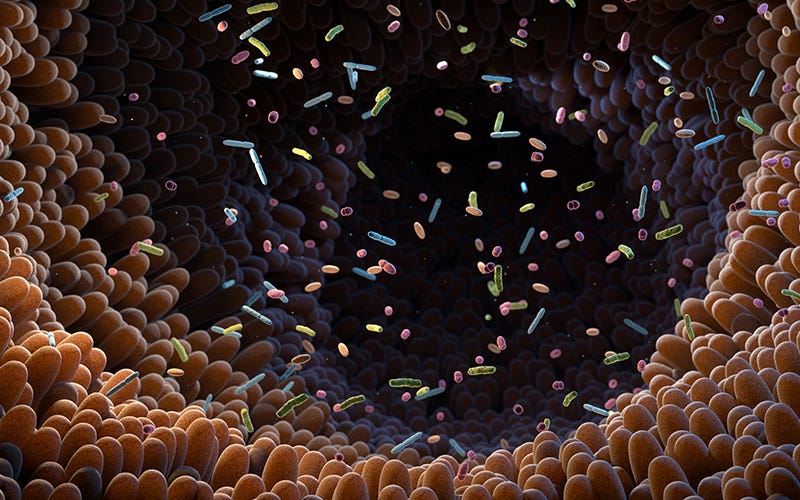
It’s been known for a while now that the gut microbiome—the collection of bacteria, yeasts, fungi and archaea in our guts—plays an important role in regulating our metabolic and hormonal health. There are some strains of bacteria, like Lactobacillus reuteri, that can increase levels of testosterone, for example. Other microbes regulate estrogen, and they’re commonly referred to collectively as the estrobolome. The estrobolome can either keep bodily levels of estrogen under control, within healthy levels, or it can send them spinning out of whack.
Researchers took samples of gut microbes from people around the world: from individuals in industrial societies, and from primitive societies, including hunter-gatherers. They took samples from people of all ages, including infants.
The researchers found that the gut microbes of people in industrial societies are much better—seven times better—at recycling estrogen. What that means, basically, is that estrogen that would otherwise be deactivated in the liver and excreted from the body is instead reactivated by microbes using a special enzyme. Rather than being excreted, it re-enters the bloodstream, increasing the hormone’s concentration and effects.
There was a larger diversity of microbes in the estrobolome of people from industrial societies.
Infants fed formula were three times better at recycling estrogen than those who were breastfed. This suggests a key influence on the ability of the estrobolome to recycle estrogen, as you might expect, is diet. The researchers believe processed foods and in particular lack of fibre may be to blame. Indigestible fibre from plant foods is a major source of food for microbes in the gut, but when adequate levels aren’t present in the diet, microbes may be forced to rely on other food sources, including deactivated estrogen, to survive.
One of my most important recommendations for fixing your hormones and your health is to avoid processed food as much as you can, and to learn how to cook so you don’t need other people to make food for you. Feed yourself properly—and the billions of micro-organisms that inhabit your gut.


