


There are only two things that scare me, dear reader, and one of them is nuclear war.
The other? Carnies. Circus folk. Nomads, you know. Smell like cabbage. Small hands.
Truth be told, I’m actually not scared of nuclear war—I was born in 1987, barely two years before the Wall fell—and it’s a long time since I’ve been anywhere near a circus.
Here are some things that do scare me. I’m not one for enclosed spaces, and I have a recurring nightmare about being forced to watch people eat with their mouths open, smacking their lips and sending half-chewed fragments of food spinning through the air and into my face. I wake up in a cold sweat every time. Worst of all, though, by far, is the fear that I myself might never be able to eat meat again. I shudder just to think of it.
I first came across the terrifying prospect of a “meat allergy”—an allergic inability to consume red meat—when I was researching my 2022 book, The Eggs Benedict Option. The book was about the plan for a global plant-based diet, and naturally I discovered some rather daft suggestions about how we’d get there: how millions upon millions of meat-eaters would be persuaded to give up their beloved steak, pork chops and bacon for the good of the planet. Or not. After all, why go to all the effort of persuading people if you can just take the decision out of their hands entirely?
I found a video of a Princeton bioethicist called S. Matthew Liao speaking at some globalist shindig in 2016. He suggested we could all be given gene therapy to make us allergic to meat, just like a natural allergy transmitted by tick bites. Problem solved. Liao also suggested gene therapy might be used to shrink us by about 25%, to reduce our carbon footprint, quite literally.
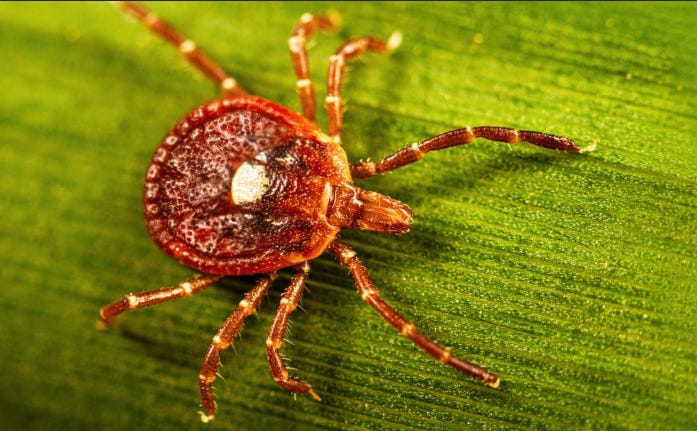
The condition Liao referred to, I soon learned, is “alpha-gal syndrome,” named after a sugar molecule that’s found only in red meat—beef, pork, lamb. A bite from a lone-star tick introduces a compound into the blood that resembles alpha-gal enough to sensitize the immune system to it. The tick gets a tasty little feast of blood, and you end up being unable to eat meat ever again. When you eat meat, your body suffers an allergic reaction. It can be so severe you die.
In fact, in 2024 there was the first recorded case of a death from alpha-gal syndrome. A 47-year-old man from New Jersey collapsed and died within hours of eating a hamburger. After an autopsy proved inconclusive, his wife went to experts at the University of Virginia’s medical school, who tested blood samples. They found the victim had been sensitized to alpha-gal, and that he had died from an extreme allergic reaction. The wife then revealed her husband had suffered a dozen or so bites on his ankles from ticks that summer. Case closed.
There’s since been a second confirmed death, in Australia.
We’ve only known about alpha-gal syndrome since the early 2000s, thanks to the testing of a cancer-drug called cetuximab. Researchers were able to show a link with the lone-star tick, and also to identify cases that stretched back into the 1990s in the southeastern US, where the tick flourishes. They identified anecdotal reports dating back even earlier, to the 1980s, including in Australia.
The CDC estimates as many as 500,000 Americans could have alpha-gal syndrome. The vast majority, of course, won’t have a diagnosis. In truth, the number is likely to be much larger.
New research suggests as many as 1 in 4 adults in some states carry antibodies for alpha-gal.
