


An unjammable fibre-optic kamikaze drone—a drone you fly directly into a target to kill it—was recently discovered in a cartel compound, 500 miles from the US border. You probably won’t have heard about this, but it’s big news. Or it should be.
It’s yet another indication of how closely drug gangs are coming to resemble state or quasi-state actors, not just in the territories they control and administer, but in the threat they pose to real states, including the US. The classic definition of the state, derived from sociologist Max Weber, is an entity that monopolizes violence within a set of given borders. And while the cartels have been using military-grade equipment like .50 calibre machine guns and rocket-propelled grenades for some time, their determined attempts to acquire the latest drone capabilities reveal a greater ambition: to achieve technological and tactical parity with second- and maybe even first-tier nations.
The kamikaze drone in question was discovered by accident, when the Mexican military searched a property in Dolores del Rio. The authorities had been alerted to possible criminal activity at the address, and when they arrived, they discovered the usual paraphernalia—bombs, guns, ammunition—associated with cartel violence. But they also discovered a weapon that, until now, has been entirely confined to warzones and to one warzone in particular.
It shouldn’t come as a surprise that South American drug cartels and paramilitaries have been paying close attention to Ukraine, where drones are revolutionising warfare in a way that even a hobbyist with a 3D printer and a chip on his shoulder can replicate. Cheap, mass-produceable weapons can be used to destroy tanks and other equipment worth tens of millions of dollars; to eliminate entire squads of soldiers single-handedly, on the battlefield or before they even arrive on it, as they sit huddled in the back of an armoured-personnel carrier; to assassinate important military and civilian leaders; or to strike deep behind enemy lines, crippling vital military, energy and communications infrastructure.
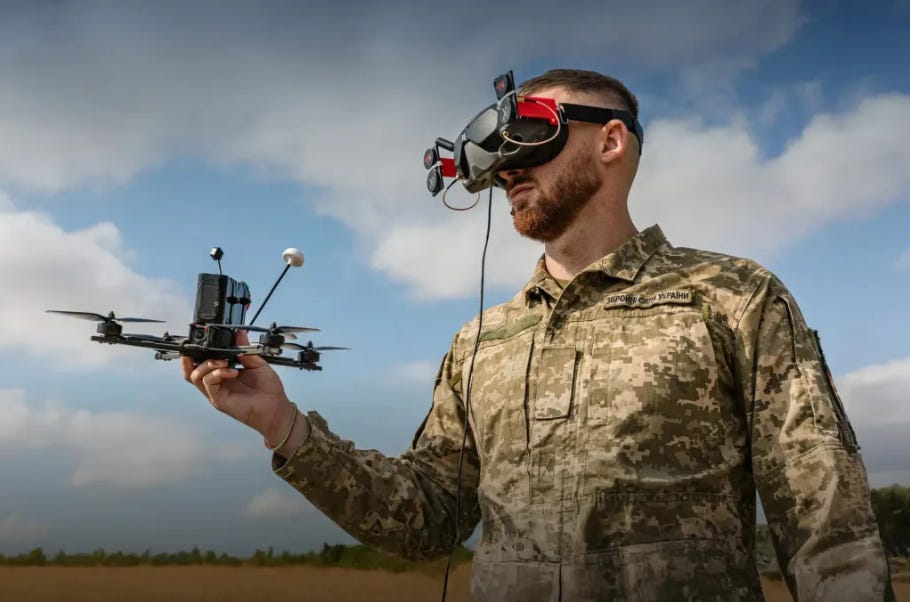
We see evidence of the brutal effectiveness of drones, often from their direct perspective (“FPV” or “first-person view”), in videos on social media, every day. As much as anything else, these videos serve as propaganda and statements of intent: to show Ukraine is still very much in the fight, and that nobody and nowhere is safe from a technology that continues to evolve at a frightening pace.
In the early stages of the war, which began in the spring of 2022, drones weren’t that important, but as the war has progressed—it’s now been going on for longer than World War I—the drone has become its signature weapon, and especially that of the battered but unbowed underdog.
Ukraine is producing millions of drones annually. The target for 2026 is between five and seven million. It’s estimated around 9,000 are deployed a day, for short-range missions over the battlefield zone, but also, increasingly, for long-range strikes far beyond Russia’s western borders. New one-way drones—drones that aren’t intended to return to sender—can travel up to 2,000 km, which puts targets in Siberia, including air bases that house Russia’s nuclear bombers, well within their range. In June of 2026, drones conducted close to 2,400 deep-strike missions in Russia.
President Zelensky’s latest “influence operation” to bring Vladimir Putin to the negotiating table within 40 days is built on targeted drone strikes against critical infrastructure that previously were off-limits, either for fear of escalation or because Ukraine lacked the ability to hit them.
The strategy appears to be working. There are fuel shortages in Russia and widespread popular anger as Russians discover that their strongman leader can no longer do what every strongman leader must: keep his own people safe.
In the crucible of war—perhaps the ultimate testing-ground and incubator of rapid innovation—the drone continues to adapt. Wireless technology, for example, has given way to wiring—miles and miles of fibre-optic cable in a spool on the back of the drone—so that it can’t be jammed by electronic countermeasures. The Ukrainians are also integrating AI targeting, allowing drones greater autonomy on the battlefield and deploying them in massed “swarms” that are almost impossible to eliminate before they hit their target.
The cartels haven’t just been watching from afar, mouths agape, like you or I. In July 2025, it was reported that cartel soldiers were being sent to Ukraine to join the “international brigades” of foreign volunteers specifically so they could learn the very latest techniques in drone-warfare. Ukraine may very well be the only country whose military offers a comprehensive training curriculum in every aspect of drone-warfare, from their and deployment, to piloting and “real-time battlefield coordination.”
Website Defense News reported, “The Security Service of Ukraine (SBU) launched a joint investigation with military intelligence after Mexico’s National Intelligence Center warned in early summer that Mexican volunteers had joined Ukraine’s foreign fighter units specifically to acquire first-person view drone capabilities. The probe has since expanded to include Colombian nationals, raising concerns about Ukraine’s inadvertent role as a training ground for transnational criminal organizations…
“The investigation centers on several Spanish-speaking units within the International Legion, particularly the tactical group ‘Ethos,’ operating in the Donetsk and Kharkiv regions. Ukrainian investigators reportedly suspect that some Mexican and Colombian volunteers intentionally sought placement in drone operator units to later use this training in the service of foreign criminal organizations.
“One noteworthy case is that of a Mexican national operating under the alias ‘Águila-7,’ who registered in March 2024 using fraudulent Salvadoran documentation. Posing as a humanitarian volunteer, he completed comprehensive drone training in Lviv while demonstrating exceptional technical expertise that eventually had instructors suspicious.”
Águila-7 demonstrated “extensive technical knowledge,” including familiarity with “electronic warfare countermeasures and thermal detection avoidance.” Background checks suggested he had been a member of Mexico’s GAFE special forces, many of whom end up working for the cartels, which offer much better pay and regular bloody work.
Members of Colombia’s FARC guerrillas were also discovered among the international brigades. They had apparently travelled to Ukraine with forged Panamanian and Venezuelan papers. Further investigation revealed a sophisticated pan-Latin-American operation, where private-security firms obtained fake papers and coordinated the “placement,” via front companies, of cartel and guerrilla operatives in Ukraine.
An SBU official is quoted as saying, “We welcome volunteers in good faith. But we must now recognize that Ukraine has become a platform for the global dissemination of FPV tactics. Some come here to learn how to kill with a $400 drone, then sell this knowledge elsewhere to the highest bidder.”
