


Just a quick message from me: If you like my posts and you’re only a free subscriber, please consider upgrading to a paid subscription. It’s not much, and your contributions make it possible for me to do what I do.
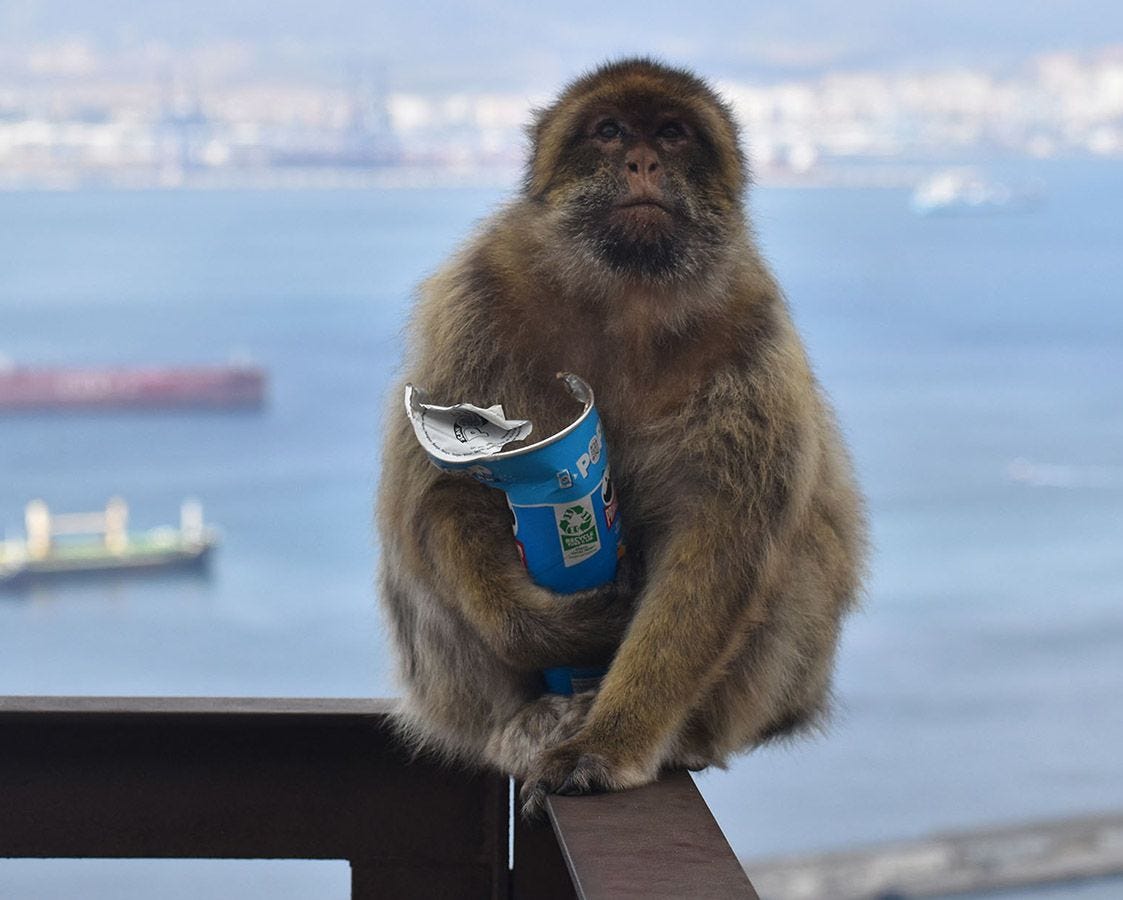
“On the rocky slopes of Gibraltar, a troop of Barbary macaques lingers near a popular tourist overlook. An adult female pauses mid-stride, crouches beside a patch of rust-red earth poking through the concrete road, and begins pinching off small fragments with surprising precision before popping them into her mouth. She chews, swallows, and moves on. It looks bizarre. But according to a new study, the dirt may help her body cope with the chocolate bars, ice cream cones, and potato chips that visitors keep slipping her despite rules against it.”
They call it “junk food” for good reason, but what if it really was, quite literally, junk—like, of less nutritional value than dirt? Well, that’s exactly what new research on the famous monkeys of Gibraltar suggests. Sort of.
Thanks to the island’s tourists, some of the monkeys now consume a significant amount of ultraprocessed food—biscuits, chocolate, bread, crisps, cheap ice cream—and they’ve also taken to eating pawfuls of calcium-rich red earth, known locally as terra rossa.
The two things seem to be closely related. While other monkey populations have been known to consume dirt, none does it quite like the macaques of this strategically vital rocky little British colony, perched between Europe and Africa.
Over a period of about two years, researchers spent hundreds of hours observing 230 monkeys. During that time, they counted 46 separate incidents of what appeared to be deliberate dirt-eating.
By examining the sites where the monkeys foraged the dirt, the researchers were able to establish the creatures had not been digging up insects, seeds or eggs: They wanted to eat the dirt. The researchers also studied video footage of the dirt-eating and noted a distinctive pattern of harvesting and eating that looked totally different from the monkeys’ normal “ground-feeding postures.” The monkeys ate smaller pieces of dirt and even larger fragments measuring centimeters across.
The vast majority of the dirt-eating took place among groups living on the central and upper portions of the great rock, where the terra rossa—and the tourists—are most heavily concentrated.
Tourist numbers drove the behaviour. When more tourists were around, in the summer months, the monkeys ate more human food, and they also ate more dirt.
On a number of occasions, researchers saw monkeys eat dirt directly after consuming human food.
Monkeys in the area called Middle Hill, by contrast, logged no human contact during the study, and not a single case of dirt-eating was recorded. Interestingly, other researchers who had studied the monkeys of Middle Hill many years earlier, when the monkeys there did come into regular contact with tourists and military personnel, said they remembered incidents of dirt-eating.
The researchers have two theories to explain the monkeys’ behavior. The first is that the monkeys were eating the clay as a kind of buffer or detoxicant. Ultraprocessed food couldn’t be more different from the monkeys’ natural diet—herbs, leaves, seeds and a small amount of insects—and the researchers believe this could irritate their digestive systems and cause harmful changes to the composition of their gut flora. Particular kinds of clay are known to absorb harmful substances in the gut, alter stomach acidity and promote the growth of beneficial bacteria.
The second explanation—the explanation I favour—is that consumption of human foods is causing malnutrition in the monkeys, deficiencies in key minerals and nutrients, which they attempt to remedy by eating the clay.
